We use comparatives (bigger, more expensive) to compare two people or things, and superlatives (the biggest, the most expensive) to compare one person or thing with a whole group. The form depends on the length of the adjective: short adjectives take -er / -est, and long adjectives take more / most.
When to use comparatives and superlatives
Comparatives: two things
Use a comparative when you compare two people, things, places or times. We usually add than before the second thing.
- My brother is taller than me.
- The train is faster than the bus.
- This phone is more expensive than my old one.
- I’m happier now. (We know the comparison: happier than before.)
Superlatives: one from a group
Use a superlative when you compare one thing with three or more things, or with all the others in a group. We usually put the before it.
- Mia is the tallest student in our class.
- This is the cheapest café in town.
- It was the most interesting film of the year.
How to form comparatives and superlatives
One-syllable adjectives: -er / -est
Most short adjectives add -er for the comparative and -est for the superlative.
| Adjective | Comparative | Superlative |
|---|---|---|
| old | older | the oldest |
| cheap | cheaper | the cheapest |
| fast | faster | the fastest |
| long | longer | the longest |
Spelling rules
Some adjectives change their spelling when you add -er or -est.
| Rule | Adjective | Comparative | Superlative |
|---|---|---|---|
| Ends in -e: add -r / -st | nice, large | nicer, larger | the nicest, the largest |
| One vowel + one consonant: double the consonant | big, hot, thin | bigger, hotter, thinner | the biggest, the hottest, the thinnest |
| Consonant + -y: change y to i | happy, easy, busy | happier, easier, busier | the happiest, the easiest, the busiest |
Do not double the consonant when the word ends in two vowels + consonant or in -w / -y: cheap → cheaper, new → newer, grey → greyer.
Two-syllable adjectives ending in -y
These follow the -y rule above, even though they have two syllables: funny → funnier → the funniest, pretty → prettier → the prettiest, heavy → heavier → the heaviest.
Other two-syllable and longer adjectives: more / most
Most other adjectives with two syllables, and all adjectives with three or more syllables, use more and the most. The adjective itself does not change.
| Adjective | Comparative | Superlative |
|---|---|---|
| boring | more boring | the most boring |
| famous | more famous | the most famous |
| expensive | more expensive | the most expensive |
| beautiful | more beautiful | the most beautiful |
| comfortable | more comfortable | the most comfortable |
A few two-syllable adjectives can take either form, for example quiet, simple, clever, narrow: quieter or more quiet. At A2, the -er form is the safer choice for these words.
Irregular forms
A small number of very common adjectives are irregular. Learn them by heart.
| Adjective | Comparative | Superlative |
|---|---|---|
| good | better | the best |
| bad | worse | the worst |
| far | farther / further | the farthest / the furthest |
| much / many | more | the most |
| little (amount) | less | the least |
- Today is better than yesterday.
- That was the worst meal I’ve ever had.
- My school is further from my house than yours.
Sentence patterns
Comparative + than
After than, use an object pronoun (me, him, her, us, them) in everyday English, or a subject pronoun + verb.
- She’s older than me.
- She’s older than I am.
Both are correct. She’s older than I is very formal and sounds unusual in conversation.
The + superlative + in / of
After a superlative, use in with places and groups (in the world, in my family, in the class) and of with time periods or a number of things (of the year, of all, of the three).
- It’s the highest mountain in Europe.
- Friday is the busiest day of the week.
The present perfect with ever is very common after superlatives: It’s the best book I’ve ever read.
Affirmative, negative and question forms
| Form | Comparative | Superlative |
|---|---|---|
| Affirmative | London is bigger than Paris. | Tokyo is the biggest city in the world. |
| Negative | My flat isn’t bigger than yours. | It isn’t the most expensive hotel in the city. |
| Question | Is your flat bigger than mine? | What’s the most expensive hotel in the city? |
Making the difference bigger or smaller
Put these words before a comparative to show how big the difference is:
- big difference: much, a lot, far – The new laptop is much faster than the old one.
- small difference: a bit, a little, slightly – Can you speak a bit slower, please?
Do not use very with comparatives: say much better, not very better.
Less and the least
Less and the least are the opposite of more and the most. They work with adjectives of any length.
- This jacket is less expensive than that one.
- It was the least interesting part of the trip.
With short adjectives, English speakers usually prefer not as … as or the opposite adjective: The bus is slower sounds more natural than The bus is less fast.
As … as and not as … as
Use as + adjective + as to say two things are the same. The adjective stays in its normal form.
- My sister is as tall as my mum.
- The film was as good as the book.
Use not as … as to say the first thing is less than the second.
- The bus isn’t as fast as the train. (= The train is faster.)
- Today isn’t as cold as yesterday.
Comparatives with adverbs
Adverbs compare in a similar way. Short adverbs that look like adjectives take -er / -est (fast → faster, hard → harder, early → earlier). Adverbs ending in -ly use more / most.
- She runs faster than her brother.
- Please drive more carefully.
- Well and badly are irregular: better / the best, worse / the worst.
If you are not sure whether a word is an adjective or an adverb, see our guide to adjectives and adverbs of manner.
Signal words
These words often tell you which form you need:
- than → comparative: cheaper than, more popular than
- the … in / of → superlative: the best in the team, the coldest of the year
- ever after the noun → superlative: the funniest show I’ve ever seen
- much, a lot, a bit before the adjective → comparative: a lot easier
- as … as → normal adjective: as easy as
Comparative or superlative?
Ask yourself: how many things am I comparing?
- Two things → comparative: Tom is younger than Sam.
- One thing against a group → superlative: Tom is the youngest in the family.
When there are exactly two things, careful speakers sometimes use the comparative with the: Of the two jackets, the black one is the nicer. In everyday speech, many people say the nicest here, and both are understood. For tests at A2, choose the comparative with than for two things and the superlative with the for groups.
Also note the difference from too: This bag is heavier than mine compares two bags, but This bag is too heavy means it is more than you want. Our guide to too and enough explains this structure.
Common mistakes
- ✗ She is more tall than me. → ✓ She is taller than me. (One-syllable adjectives take -er, not more.)
- ✗ This is more better. → ✓ This is better. (Never use more and -er together.)
- ✗ He’s taller then his brother. → ✓ He’s taller than his brother. (Then is about time; than is for comparing.)
- ✗ It’s the most cheap shop. → ✓ It’s the cheapest shop. (Short adjectives take -est.)
- ✗ He’s best player in the team. → ✓ He’s the best player in the team. (Superlatives normally need the – see our guide to articles a, an, the.)
- ✗ She’s the oldest of the family. → ✓ She’s the oldest in the family. (Use in with groups and places.)
- ✗ My phone is as good than yours. → ✓ My phone is as good as yours. (As … as, never as … than.)
- ✗ The weather is badder today. → ✓ The weather is worse today. (Bad is irregular: worse, the worst.)
- ✗ This box is biger. → ✓ This box is bigger. (Double the final consonant after one short vowel.)
- ✗ I’m happyer now. → ✓ I’m happier now. (Consonant + y changes to i.)
- ✗ It’s very cheaper online. → ✓ It’s much cheaper online. (Use much or a lot, not very, with comparatives.)
Quick check
Complete the sentences with the correct form of the word in brackets.
- My new flat is ______ than my old one. (big)
- That was ______ film I’ve ever seen. (bad)
- Is English ______ than French? (difficult)
- August is usually ______ month of the year here. (hot)
- Our car isn’t as ______ as yours. (fast)
Answers
- bigger – one vowel + one consonant, so double the g.
- the worst – irregular superlative of bad.
- more difficult – three syllables, so use more.
- the hottest – double the t, and use the … of the year.
- fast – the adjective does not change in as … as.
Next step
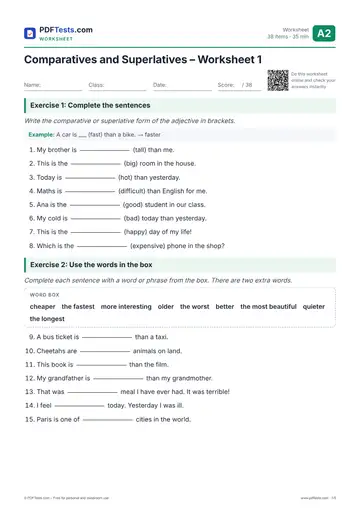
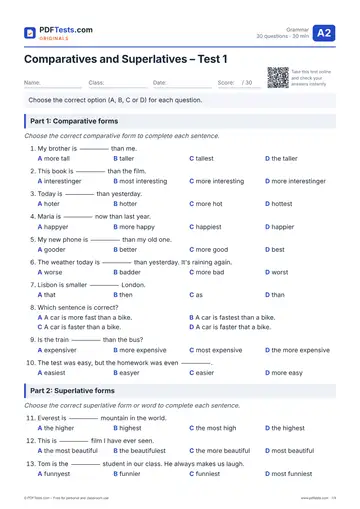
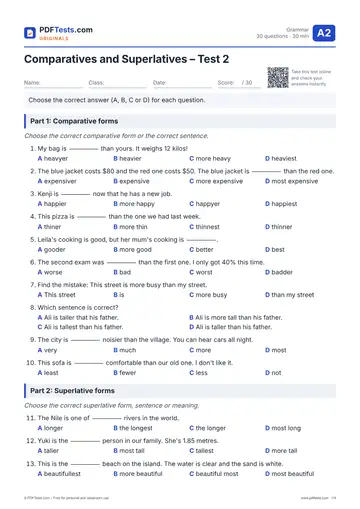
Now put the rules into practice: test yourself with our A2 Comparatives and Superlatives test, and check any wrong answers against the spelling and irregular-form tables above. When you feel confident, try more topics at the same level on our English A2 tests page, where comparatives often appear together with adverbs, quantities and the past simple.
Practise this topic: Comparatives and Superlatives
Was this page helpful?
What was the problem?
Thank you for your feedback!