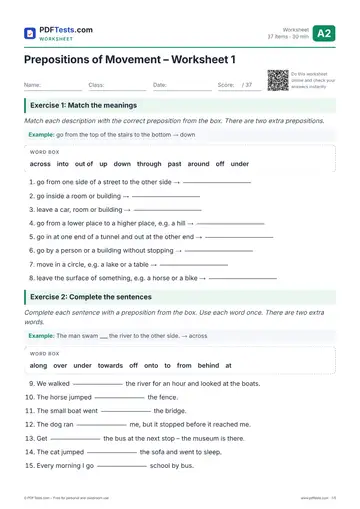
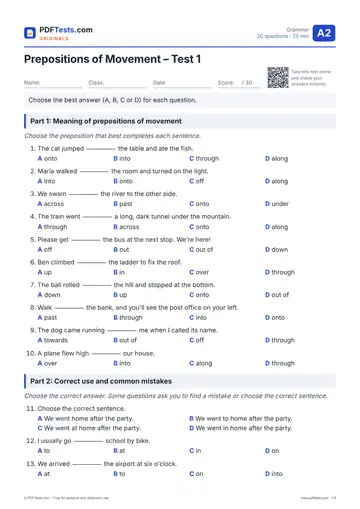
Prepositions of movement tell us where someone or something is going: to the station, into the room, across the road, through the tunnel. We use them after verbs of movement such as go, walk, run, drive, come, jump and fly. This guide shows the most common ones at A2 level, how they differ, and the mistakes learners often make.
What is a preposition of movement?
A preposition of movement shows direction: a change from one place to another. A preposition of place shows position: where something is and stays.
- The cat is in the box. (position: it is there now)
- The cat jumped into the box. (movement: it was outside, now it is inside)
If you need to review position words first, read our guide to prepositions of place (in, on, under, next to).
The basic form
The pattern is simple:
| Subject | Verb of movement | Preposition | Place / object |
|---|---|---|---|
| She | walked | into | the kitchen. |
| We | drove | through | the city. |
| The dog | ran | across | the garden. |
| I | climbed | up | the hill. |
The verb is often in the past simple when we tell stories or give directions about what happened: He ran across the road and jumped onto the bus.
The main prepositions of movement
| Preposition | Meaning | Example |
|---|---|---|
| to | in the direction of a place, and arriving there | I go to work by train. |
| from | the starting point | She came from Madrid. |
| into | from outside to inside | He walked into the shop. |
| out of | from inside to outside | She took her phone out of her bag. |
| onto | to a position on a surface | The cat jumped onto the table. |
| off | away from a surface | The book fell off the shelf. |
| up | from lower to higher | We walked up the stairs. |
| down | from higher to lower | The ball rolled down the hill. |
| across | from one side to the other (flat surface) | They swam across the river. |
| through | from one end to the other, inside something | The train went through a tunnel. |
| along | following a line | We walked along the beach. |
| over | above something, or to the other side of something high | The horse jumped over the fence. |
| under | below something, from one side to the other | The boat went under the bridge. |
| past | beside something and then further on | Walk past the bank. |
| around / round | in a circle, or to the other side of a corner | We drove around the lake. |
| towards | in the direction of (not necessarily arriving) | A man was walking towards me. |
| away from | leaving a place or person | Move away from the window. |
To and from
To shows the destination; from shows the starting point. We often use them together.
- We flew from London to Rome.
- It takes ten minutes to walk from my house to the school.
Into and out of
Into means moving from outside to inside. Out of is the opposite. Note: into is one word, out of is two words.
- She got into the taxi.
- Get out of the water, it’s cold.
Onto and off
Onto means moving to a position on top of a surface. Off means moving away from that surface.
- The child climbed onto the chair.
- Take your feet off the sofa, please.
Up and down
We use these for stairs, hills, mountains, ladders and trees. Down can also mean “along” a street in everyday speech.
- He ran up the stairs.
- Go down this street and turn right.
Across, through and along
These three are easy to confuse:
- across = from one side to the other of something flat or open: a road, a river, a field, a bridge.
- through = inside something, in one end and out the other: a tunnel, a forest, a door, a crowd.
- along = following a long line: a road, a river, a beach, a corridor.
Examples:
- Look both ways before you walk across the road.
- We walked through the forest for two hours.
- They cycled along the river to the next village.
Over and under
Over means above something, or to the other side of something high. Under means below it.
- The plane flew over the mountains.
- The cat went under the bed.
Past, around and towards
- past: you go next to something and continue. Go past the supermarket; the post office is on the left.
- around / round: in a circle, or to a place on the other side. The Earth goes around the Sun. The shop is just round the corner. (Round is more common in British English.)
- towards: in the direction of something, but we don’t say if you arrive. She was running towards the station.
Signal words: verbs of movement
Prepositions of movement usually follow verbs like these:
go, come, walk, run, drive, ride, cycle, fly, swim, climb, jump, fall, move, get, take, put, throw, travel
When you see one of these verbs, ask yourself: is this about position or direction? If it is direction, you probably need a preposition of movement.
Transport: get in, get on and more
With transport, English uses fixed combinations:
| Type of transport | Getting in | Getting out |
|---|---|---|
| car, taxi | get into / get in | get out of |
| bus, train, plane, boat | get on | get off |
| bike, motorbike, horse | get on | get off |
The rule of thumb: if you can stand up and walk inside it (bus, train, plane), use on/off. If it is small and you sit down immediately (car, taxi), use in/into and out of.
- I got off the train at the wrong station.
- She got into the car and drove away.
You can practise this vocabulary in our A2 Travel and Transport test.
Movement vs place: the key difference
Many movement prepositions have a matching place preposition:
| Place (position) | Movement (direction) |
|---|---|
| She is in the kitchen. | She went into the kitchen. |
| The keys are on the table. | I put the keys onto the table. |
| He is at the station. | He went to the station. |
In everyday English, people often say in and on after verbs of movement too: He jumped in the pool. Put it on the table. This is correct and natural. But into and onto make the movement clearer, and in tests they are usually the expected answer after verbs like jump, walk, run and fall.
However, at and to are never interchangeable here: go to the station (movement), be at the station (position).
Special cases without a preposition
Some words never take to after go, come or get:
- home: I went home early. (not to home)
- here / there: Come here. We went there last summer.
- downstairs / upstairs: She ran upstairs.
- abroad: They travel abroad every year.
Arrive in, arrive at
We never say arrive to.
- arrive in + city or country: We arrived in Tokyo at midnight.
- arrive at + building or smaller place: We arrived at the hotel at 1 a.m.
Common mistakes
✗ I went to home after the party. → ✓ I went home after the party. Home doesn’t take to after verbs of movement.
✗ We arrived to the airport at six. → ✓ We arrived at the airport at six. Arrive takes at or in, never to.
✗ Let’s go to there tomorrow. → ✓ Let’s go there tomorrow. There and here never take to.
✗ She got on the taxi. → ✓ She got into the taxi. Use get into / get in for cars and taxis.
✗ I got off from the bus. → ✓ I got off the bus. Get off needs no extra from.
✗ We walked across the forest. → ✓ We walked through the forest. A forest surrounds you, so use through.
✗ The train went across the tunnel. → ✓ The train went through the tunnel. With tunnels you are inside, so use through.
✗ He came out the room. → ✓ He came out of the room. In standard British English, out needs of before a noun.
✗ The ball fell of the table. → ✓ The ball fell off the table. Off (movement away) and of are different words.
Giving directions
Prepositions of movement are essential for directions. Notice how they work together:
Go out of the station and turn left. Walk along Park Road and go past the cinema. Go across the bridge and walk up the hill. The museum is at the top.
Try describing your own route from home to work or school using at least four prepositions from this guide.
Quick check
Choose the correct preposition (or write – if no preposition is needed).
- We drove ___ a long tunnel under the mountain.
- Please get ___ the bus at the next stop.
- She jumped ___ the swimming pool and swam to the other side.
- Walk ___ the bank. The café is just after it, on the right.
- I’m really tired. Let’s go ___ home now.
Answers
- through – you are inside the tunnel.
- off – we use get off for buses.
- into – from outside the water to inside it (in is also possible in informal English).
- past – you go beside the bank and continue.
- – – no preposition: go home.
Next step
Now put what you’ve learned into practice: test yourself with our A2 Prepositions of Movement test, which mixes direction words, transport phrases and the special cases above. If you mix up in and into or at and to, go back over position words with the A1 Prepositions of Place test, and then explore more topics at your level on our English A2 tests page.
Practise this topic: Prepositions of Movement
Was this page helpful?
What was the problem?
Thank you for your feedback!