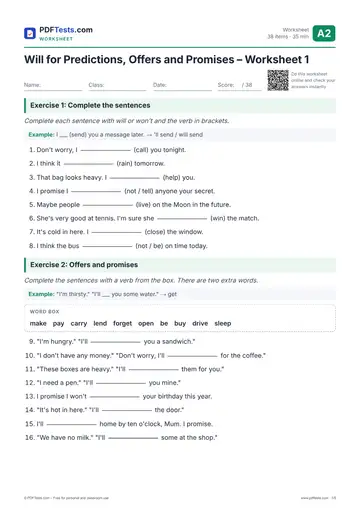
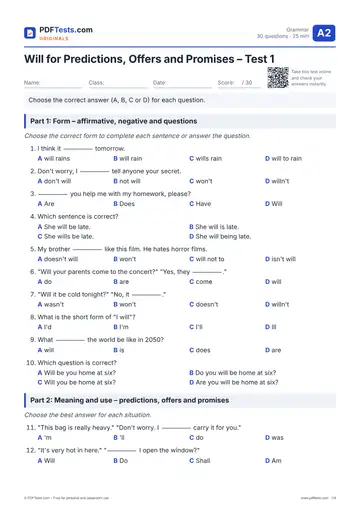
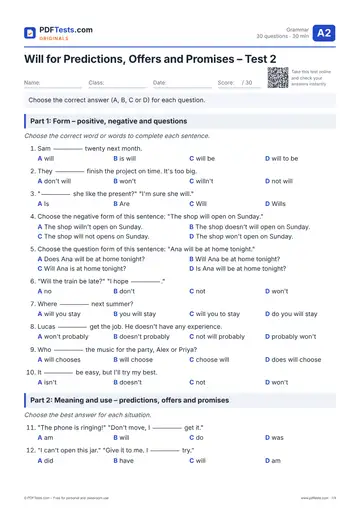
We use will + base verb to talk about the future when we predict something, decide something at the moment of speaking, offer help or make a promise. Will is the same for every person (I, you, he, she, we, they), so the form is easy to learn. The challenge is knowing when to use it, especially when you compare it with be going to.
Form of will
Will is a modal verb. It never changes, and the verb after it is always the base form (no to, no -s, no -ing).
Affirmative
| Subject | will / ’ll | Base verb | Example |
|---|---|---|---|
| I / You / We / They | will (’ll) | help | I’ll help you with that bag. |
| He / She / It | will (’ll) | rain | It’ll rain later. |
In speaking and informal writing we usually use the short form ’ll: I’ll, you’ll, he’ll, she’ll, it’ll, we’ll, they’ll.
Negative
| Subject | will not / won’t | Base verb | Example |
|---|---|---|---|
| I / You / We / They | won’t | forget | I won’t forget your birthday. |
| He / She / It | won’t | be | She won’t be late. |
The short form of will not is won’t. The full form will not sounds stronger or more formal.
Questions and short answers
| Will | Subject | Base verb | Short answers |
|---|---|---|---|
| Will | you | come to the party? | Yes, I will. / No, I won’t. |
| Will | she | pass the exam? | Yes, she will. / No, she won’t. |
| Will | they | win? | Yes, they will. / No, they won’t. |
In short answers, do not use the contraction in positive answers: say Yes, I will, not Yes, I’ll.
Wh- questions follow the same pattern: What will you do after university? Where will they stay?
Pronunciation notes
- ’ll is very short: I’ll sounds like “aisle”, we’ll sounds like “wheel”.
- won’t (/wəʊnt/) rhymes with don’t. Don’t confuse it with want (/wɒnt/): I won’t go (future negative) is very different from I want to go (desire).
When to use will
1. Predictions based on opinion
Use will to say what you think or believe about the future, often without clear evidence.
- I think Spain will win the match.
- In 2050, most cars will be electric.
- You’ll love this film. It’s really funny.
- Don’t worry. Everything will be fine.
Predictions often start with I think, I’m sure, I expect, I hope or include probably, definitely, maybe, perhaps.
2. Quick decisions (decided now)
Use will when you decide at the moment of speaking. There is no plan before.
- “The phone’s ringing.” “I’ll get it.”
- “We’ve got no milk.” “OK, I’ll buy some on the way home.”
- I’m tired. I think I’ll go to bed.
- (In a café) I’ll have a cappuccino, please.
3. Offers
Use I’ll or we’ll to offer to do something for someone.
- That bag looks heavy. I’ll carry it for you.
- Don’t cook tonight. We’ll order pizza.
To ask if someone wants your help, use Shall I…? or Shall we…? (common in British English):
- Shall I open the window?
- Shall we meet at six?
4. Promises
Use will or won’t to promise something.
- I’ll call you as soon as I land.
- I won’t tell anyone your secret.
- I promise I’ll pay you back tomorrow.
5. Requests
Use Will you…? to ask someone to do something. It is quite direct; Can you…? or Could you…? is often more polite.
- Will you help me with this box, please?
- Will you close the door?
6. Refusals
Won’t can mean that a person or thing refuses to do something.
- My little brother won’t eat vegetables.
- The car won’t start.
Word order with probably and definitely
Adverbs like probably and definitely go after will in affirmative sentences but before won’t in negative sentences.
| Sentence type | Word order | Example |
|---|---|---|
| Affirmative | will + probably + verb | She’ll probably be late. |
| Negative | probably + won’t + verb | She probably won’t come. |
With I think, put the negative in think: I don’t think it will rain is more natural than I think it won’t rain.
Signal words
These words and phrases often appear with will:
- Opinion: I think, I don’t think, I’m sure, I expect, I hope, I believe
- Certainty: probably, definitely, certainly, maybe, perhaps
- Future time: tomorrow, next week, next year, soon, one day, in ten years, in 2040
- Promises and offers: I promise, don’t worry, shall I…?
Remember: future time words do not automatically mean will. I’m meeting Sam tomorrow and I’m going to visit my aunt next week are also correct. The meaning decides the form.
Will or be going to
Learners often mix these two forms. Here is the basic difference at A2 level. For a full explanation of the other form, read our guide to be going to.
| will | be going to | |
|---|---|---|
| Decisions | Decided now: I’ll call him. | Decided before (a plan): I’m going to call him tonight. |
| Predictions | Opinion or belief: I think it’ll be sunny. | Evidence you can see now: Look at those clouds. It’s going to rain. |
Compare:
-
“Is there any coffee?” “No, but I’ll make some.” (decision now)
-
I’m going to make a cake for Mia’s birthday. I bought the eggs yesterday. (plan)
-
I think the new teacher will be nice. (opinion)
-
Be careful. You’re going to drop those plates. (I can see it happening)
In many predictions both forms are possible and the difference is small. When there is clear evidence in front of you, going to is more natural. When you decide or offer at the moment of speaking, use will.
When you feel confident with both, you can compare all future forms, including the present continuous for arrangements, in our Future Forms guide.
Will after if and when
After if and when in a sentence about the future, use the present simple, not will. Use will in the other part of the sentence.
- If it rains, we’ll stay at home.
- When I get home, I’ll send you the photos.
This pattern is called the first conditional. You can learn more in our guide to the first and second conditional.
Common mistakes
-
✗ I will to call you tomorrow. → ✓ I will call you tomorrow. Will is followed by the base verb without to.
-
✗ She wills come to the party. → ✓ She will come to the party. Will never takes -s, and the main verb doesn’t either.
-
✗ Will you to help me? → ✓ Will you help me? In questions, too, use the base verb after the subject.
-
✗ “The doorbell’s ringing.” “I’m going to open it.” → ✓ “I’ll open it.” A decision made at the moment of speaking needs will.
-
✗ Will I carry your bag? → ✓ Shall I carry your bag? To offer help in a question, use Shall I…?
-
✗ He will be probably late. → ✓ He will probably be late. Probably goes between will and the main verb.
-
✗ I think she won’t like it. → ✓ I don’t think she’ll like it. With think, English usually makes think negative.
-
✗ When I will arrive, I’ll text you. → ✓ When I arrive, I’ll text you. Use the present simple after when and if for the future.
-
✗ I want go to the cinema later. (meaning “I will not”) → ✓ I won’t go to the cinema later. Won’t = will not; want = desire. They sound similar but mean different things.
Quick check
Choose or complete the correct form.
- “I’m cold.” “I ___ close the window.” (will / am going to)
- Don’t worry, I ___ (not / tell) anybody.
- ___ I make you a sandwich? (Will / Shall)
- Put probably in the correct place: They won’t win the final.
- Correct the mistake: If she will call, I’ll tell you.
Answers
- will (I’ll close the window) – a quick decision and an offer.
- won’t tell – a promise in the negative.
- Shall – an offer in question form.
- They probably won’t win the final.
- If she calls, I’ll tell you. – present simple after if.
Next step
Now put the rules into practice: test yourself with our A2 Will for Predictions, Offers and Promises test, which mixes predictions, offers, promises and quick decisions. If you still hesitate between the two main future forms, try the A2 Be Going To test next and notice when a plan or visible evidence changes your answer.
Was this page helpful?
What was the problem?
Thank you for your feedback!