The present simple (I work) describes habits, routines, facts and things that are generally true. The present continuous (I am working) describes actions happening now, around now, or temporary situations. The choice depends on one question: is this a regular or permanent thing, or is it happening now or only for a short time?
The basic difference
Compare these two sentences:
- I drink coffee every morning. (a habit: it happens again and again)
- I*’m drinking** coffee right now.* (an action in progress at this moment)
Here is a quick summary:
| Present simple | Present continuous |
|---|---|
| Habits and routines | Actions happening now |
| Facts and general truths | Actions happening around now (this week, these days) |
| Permanent situations | Temporary situations |
| State verbs (know, like, want) | Changing or developing situations |
| Timetables | Future plans and arrangements |
When to use the present simple
Habits and routines
Use the present simple for things you do regularly.
- She goes to the gym three times a week.
- We have dinner at seven.
- I don’t watch TV in the morning.
Facts and general truths
Use it for things that are always or generally true.
- Water boils at 100°C.
- Cats sleep a lot.
- The sun rises in the east.
Permanent situations
Use it for situations that are not going to change soon.
- My parents live in Manchester.
- He works for a bank.
Timetables
Use it for fixed schedules, like trains, films and classes.
- The train leaves at 8:15.
- The film starts at nine.
For a full explanation of this tense, see our guide to the present simple.
When to use the present continuous
Actions happening now
Use the present continuous for actions in progress at the moment of speaking.
- Be quiet. The baby*’s sleeping**.*
- I*’m talking** on the phone. Can you wait a minute?*
- Look. It*’s snowing**.*
Actions happening around now
The action does not need to be happening at this exact second. It can be happening in this period of time.
- I*’m reading** a great book at the moment.* (You are not reading it while you speak.)
- Tom is learning Spanish this year.
Temporary situations
Use it for situations that are true now but will probably change.
- I usually live in Madrid, but this month I*’m staying** with my aunt in London.*
- She*’s working** from home this week because her office is closed.*
Changing situations
Use it to describe things that are changing or developing.
- Prices are going up.
- Your English is getting better.
Future arrangements
You can also use it for fixed plans in the future, usually with a time expression.
- We*’re meeting** Sam on Saturday.*
This use is explained in our guide to future forms. For more on the tense itself, read the present continuous guide.
Form
Present simple
| Affirmative | Negative | Question | |
|---|---|---|---|
| I / you / we / they | I work | I don’t work | Do you work? |
| he / she / it | She works | She doesn’t work | Does she work? |
Short answers: Yes, I do. / No, I don’t. / Yes, she does. / No, she doesn’t.
Remember: add -s or -es only for he, she, it in affirmative sentences. After doesn’t and does, use the base verb: She doesn’t work. (not works)
Present continuous
Form: am / is / are + verb-ing
| Affirmative | Negative | Question | |
|---|---|---|---|
| I | I**’m working** | I**’m not working** | Am I working? |
| he / she / it | He**’s working** | He isn’t working | Is he working? |
| you / we / they | They**’re working** | They aren’t working | Are they working? |
Short answers: Yes, I am. / No, I’m not. / Yes, he is. / No, he isn’t. / Yes, they are. / No, they aren’t.
Spelling notes
Present simple (he / she / it):
- Most verbs: add -s: play → plays, read → reads
- Verbs ending in -s, -sh, -ch, -x, -o: add -es: watch → watches, go → goes, do → does
- Consonant + y: change y to -ies: study → studies (but play → plays)
- Irregular: have → has
Present continuous (-ing):
- Most verbs: add -ing: eat → eating
- Verbs ending in -e: remove e: make → making, write → writing
- Short verbs ending in one vowel + one consonant: double the consonant: run → running, sit → sitting, swim → swimming
- Verbs ending in -ie: change to -ying: lie → lying, die → dying
Signal words
Certain time expressions help you choose the right tense.
| Present simple | Present continuous |
|---|---|
| always, usually, often, sometimes, rarely, never | now, right now, at the moment |
| every day / week / year | today, this week, this month |
| on Mondays, at weekends | these days, currently |
| once a week, twice a month | Look! Listen! |
| in the morning, in the evening | still |
- I often cycle to work, but today I*’m taking** the bus.*
- Listen. Someone*’s playing** the piano.*
Adverbs like always and usually normally go before the main verb. Learn more about their position in our guide to adverbs of frequency.
Signal words are useful, but always think about the meaning. Now can appear with the present simple when the situation is new and permanent: We live in Leeds now.
State verbs: usually not in the continuous
Some verbs describe states (feelings, thoughts, possession), not actions. We normally use them in the present simple, even when we mean now.
| Type | Common state verbs |
|---|---|
| Feelings | like, love, hate, want, need, prefer |
| Thinking | know, understand, believe, remember, forget, mean |
| Possession | have (= own), belong, own |
| Senses and appearance | seem, look like, sound |
- ✓ I know the answer. (not I’m knowing)
- ✓ She wants a new phone. (not She’s wanting)
- ✓ This bag belongs to me.
Verbs with two meanings
A few verbs can be states or actions, with a different meaning.
- I think it’s a good idea. (think = opinion: present simple)
- I*’m thinking** about my holiday.* (think = the process in your head: continuous OK)
- They have two cars. (have = own: present simple)
- They*’re having** lunch.* (have = eat: continuous OK)
Side by side: the same verb, different meaning
Look at how the meaning changes:
- He plays football. (He is a footballer or plays regularly.)
He*’s playing** football.* (He is on the pitch now.) - What do you do? (What is your job?)
What are you doing? (What is your action at this moment?) - I live in Rome. (my permanent home)
I*’m living** in Rome this year.* (a temporary situation) - It rains a lot in Ireland. (a general fact)
It*’s raining**. Take an umbrella.* (right now)
Common mistakes
- ✗ I’m knowing her brother. → ✓ I know her brother.
Know is a state verb, so use the present simple. - ✗ Look. It rains. → ✓ Look. It’s raining.
The action is happening now, so use the present continuous. - ✗ I’m usually getting up at seven. → ✓ I usually get up at seven.
A routine needs the present simple. - ✗ She working at the moment. → ✓ She’s working at the moment.
The present continuous needs am / is / are. - ✗ He is work now. → ✓ He is working now.
After am / is / are, use the -ing form. - ✗ Do you watching TV? → ✓ Are you watching TV?
Questions in the continuous use am / is / are, not do. - ✗ What do you do now? I’m cooking. → ✓ What are you doing now? I’m cooking.
What do you do? asks about your job, not your current action. - ✗ She doesn’t likes coffee. → ✓ She doesn’t like coffee.
After doesn’t, use the base verb without -s.
Quick check
Complete each sentence with the present simple or present continuous.
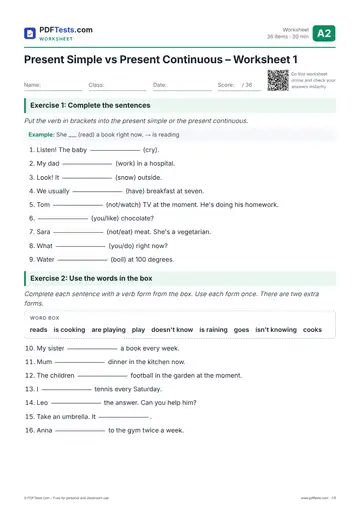
- Listen. The baby ___ (cry).
- My dad ___ (work) in a hospital.
- Sorry, I ___ (not understand) this word.
- ___ you usually ___ (walk) to school?
- I can’t talk now. I ___ (drive).
Answers
- is crying (Listen shows the action is happening now.)
- works (a permanent situation)
- don’t understand (understand is a state verb)
- Do … walk (usually shows a routine)
- ’m driving / am driving (an action in progress now)
Next step
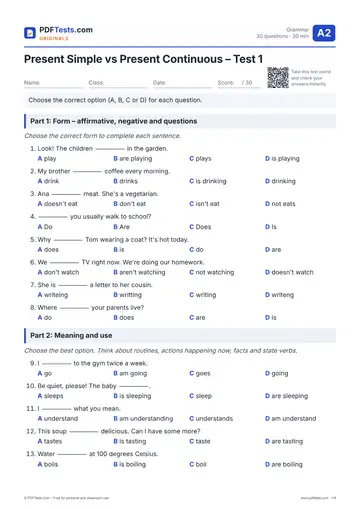
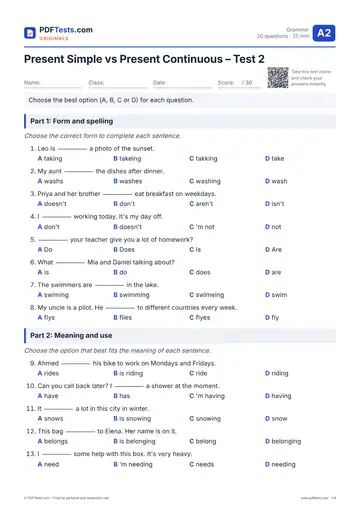
Now practise choosing between the two tenses in real sentences: test yourself with our A2 Present Simple vs Present Continuous test. As you answer, ask yourself the key question each time: is this a habit, fact or state, or is it happening now or only for a short time? If you make mistakes with the forms, go back to the tables above, then try the test again until the choice feels automatic.
Was this page helpful?
What was the problem?
Thank you for your feedback!